
Why Mindfulness and Meditation Doesn’t Work for Everyone… and How To Fix That
Having practised and taught mindfulness for over ten years, I frequently hear, “Good for you, but mindfulness/meditation just doesn’t work for me.”
And honestly? I spent my entire 20s shutting down the suggestion to meditate — often using a version of that same response, so I get it. I truly do.
Meditation was presented to me as a way to relax and be less ‘hyper.’ As someone who thrives on excitement and under pressure, it felt like people were criticising my personality, wanting me to change and to soften my edge. I did not take kindly to that implication, even when well-intentioned. So I used ‘Meditation doesn’t work for me.’ as a get-out-of-jail-free card until I was 33, when a health and work crisis ‘forced’ me to try mindfulness.
The year was 2016, and mindfulness saved my surgical career. But it was only in 2020, after I became a mother, that mindfulness changed my whole life. My meditation practice helped me become more myself than ever before, while feeling a greater ease in my skin. I also experienced unbridled joy for the first time in my life — spontaneously and often — as a direct result of my mindfulness practice. I developed a reproducible method to stop overthinking and process emotional overwhelm. In this blog series, I hope to share with you all that mindfulness has taught me.
But having experienced these gifts of mindfulness, and having faced my own version of so many legitimate concerns that people have with meditation, I truly believe this:
Mindfulness is the birthright of every single human being. Everyone deserves to experience the benefits that come from a regular mindfulness practice that is integrated into their life. This, however, does not mean that anyone should force themselves to meditate in a particular way.
There are many ways in which mindfulness practices can be modified to suit a person’s life, schedule, and even more importantly, their personality, and any conditions — physical (like asthma or chronic pain) or mental (like anxiety or depression) — that they may have. It also helps to go back to the very basics and get clear on what exactly mindfulness is, the different ways to practise mindfulness, as well as the role of meditation in this entire process.
In this article, I will put on my surgeon’s hat (or scrub cap, if you prefer!) and take a closer look at the ‘chief complaint’ that mindfulness/meditation doesn’t work. There are several reasons behind this, and unless we get clear on which ‘diagnosis’ is responsible for you feeling like mindfulness isn’t for you, it is impossible to offer tangible solutions that work. In my experience, the complaint is real, but the reasons are varied and specific, and the solutions are precise and workable. So without further ado, let’s get this clinic started and consider…
What People Mean When They Say Mindfulness Doesn’t Work
I always ask people what they mean when they say mindfulness and/or meditation doesn’t ‘work’ for them. It is a very broad statement, isn’t it? And over many conversations and workshops, I have realised that it actually means different things to different people.
I used it as a cop-out because I was resistant to the idea of meditation. But this isn’t true of most people who make that statement. Many have downloaded mindfulness apps, or attended a session, and have genuinely tried to meditate, only to find that they don’t feel calm and, sometimes, actually feel worse after meditating. Others struggle with the process of meditation itself — unable to close their eyes, to focus on their breath, or to quieten their minds.
Probing deeper, I often find that there is an expectation mismatch. Mindfulness is frequently sold to us as a gentle practice, a way to relax when life gets stressful. Meditation is actually used to sell aromatic candles, sound bowls, rugs, and retreats — all the trappings of a Zen aesthetic — instead of being presented as a practice that is gritty and messy, like going to the gym for the first time. And this expectation mismatch isn’t benign, because it sets us up for failure.
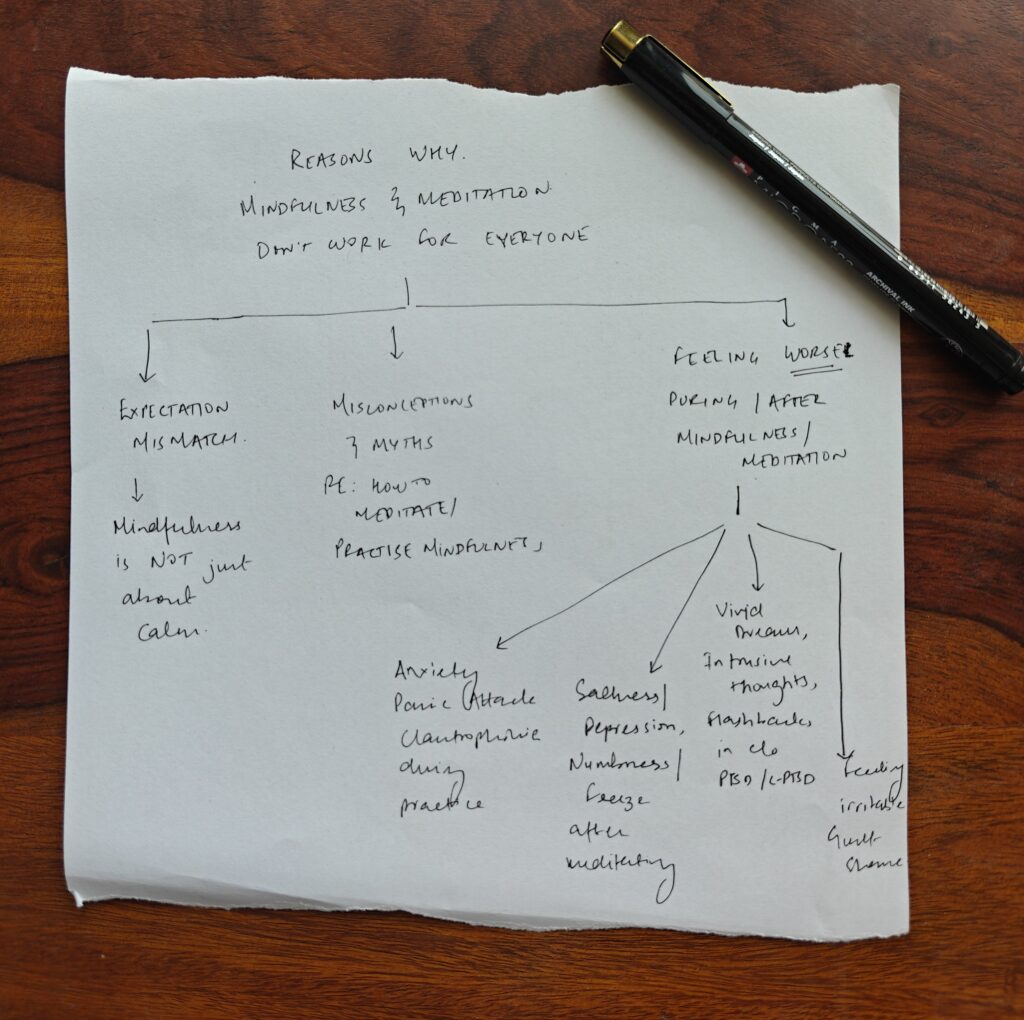
In the rest of this article and across this series of posts, we will look at the main reasons mindfulness and meditation can feel like they aren’t working:
- A mismatch in expectations — what we’ve been led to believe mindfulness will deliver versus what it actually does
- A misunderstanding of the process of meditation itself, including some very persistent myths worth busting
- Feeling worse after meditating, which can show up in several distinct ways:
- Anxiety, claustrophobia, or panic attacks during or after meditation
- Sadness, grief, or even depression after meditation
- Irritability, guilt, or shame after practising mindfulness for a while
- Trauma responses — vivid dreams, intrusive thoughts, or flashbacks after meditating
While this article summarises each of these reasons, the linked posts explore each situation in greater depth and offer both scientific explanations for them, as well as specific and practical solutions for each.
Mindfulness Is Not Just About Feeling Calm
People are made to believe that practising mindfulness will turn them into a calm person who never loses their cool, or that they will feel relaxed every time they meditate. While equanimity is one of the eight fruits of a regular mindfulness practice, it would be wrong to equate equanimity with being calm or feeling relaxed. Unfortunately, that is what most of the messaging around mindfulness meditation seems to promote.
Now, I don’t blame anyone for latching onto mindfulness as a way to experience calm. In these stressful times, with the fast-paced lives we all lead, we all want to feel more relaxed and in control. But the expectation that mindfulness will deliver calm (like a food delivery app — within 30 minutes!) often turns away those who need it and would benefit from it the most when it does not live up to that unrealistic expectation.
Instead, mindfulness practice is about learning to stay present, even in the face of difficulty, even when one is experiencing an internal storm. It is about cultivating a non-judgemental attitude, no matter what, and acting from a sense of compassion.
People who are caring and conscientious, who think deeply about their behaviour and its implications, who strive to work hard and with integrity — at their profession, at parenting — these are the people most prone to overthinking and emotional overwhelm. Mindfulness can help them develop true self-compassion as the foundation of the compassion they so easily offer others, and to learn to nurture and care for themselves, while also building the capacity to continue the good work they do.
It really is a very practical approach to living a life that feels worthy, with an inner sense of steadiness. But we miss all of this when we equate mindfulness with calm and reduce meditation to a relaxation tool.
In order to reap the true, deep, and long-lasting benefits of mindfulness, it is essential to understand what exactly mindfulness is, the ‘right’ way to meditate (I use ‘right’ ironically, as you will find out that the right way to meditate is often the way that suits you, rather than a prescribed set of rules), and how to integrate mindfulness into our daily lives — instead of hoping that the benefits of meditating for an hour each day, locked up alone in our room, will spill over into our lives and relationships.
In fact, calm is overrated. We live in a world that runs on oppressive and patriarchal systems, and in these times, what we need is righteous anger, clarity, and moral courage. Any mindfulness or meditation practice that purports to offer peace when the world is burning is, at best, a placebo, and at worst, a tool for dissociation that equates numbness with calm. This isn’t truly what most conscientious and caring people are looking for when they seek calm, and I don’t blame those who turn away from mindfulness and meditation when this is what’s on offer.
So there are two distinct concepts here:
One is that mindfulness and meditation cannot deliver calm or stress relief on demand, and we should not expect them to.
The second is that we should distinguish between feeling calm and numbing out.
The actual benefit of mindfulness — equanimity — includes, but is not limited to, a sense of calm. We will explore what equanimity in modern times actually means in another article. For now, I would like to leave you with a question to sit with:
What do you hope to receive each time you meditate? What are your wishes for a long-term mindfulness practice?
Why Meditation Can Feel Difficult
A big part of my resistance to meditation was the whole spiel about sitting still and closing your eyes. While I did eventually learn to sit and meditate, I soon realised that neither stillness nor sitting is a prerequisite for mindfulness meditation.
Besides the fact that one can meditate while lying down, there is a whole mindfulness practice dedicated to mindfulness in motion — the walking meditation. But even when one sits, as for breath-focused meditation, one does not have to be perfectly still. You can incorporate any movements you make — whether it’s adjusting your posture or fidgeting — into your practice by bringing a non-judgemental awareness to them.
‘Close your eyes’ is another common instruction during meditation. While closing your eyes can be helpful to cut off visual distractions, it is absolutely not essential — especially if you are prone to claustrophobia or panic, as we will see below. You can just as well soften your gaze and pick a neutral spot in the distance to rest your eyes on. After all, one has to keep their eyes open during walking meditation — so insisting on closing them during sitting practices makes no sense!
Any request to close your eyes during meditation should be taken as exactly that — a request, or even better, a suggestion. It is important for the person meditating to keep a sense of agency over their own body, and the decision to keep your eyes closed or open is entirely yours.
Finally, I want to address the common misconception that one has to ’empty one’s mind of thoughts’ during meditation, or attempt to quieten the mind in some way. Studies suggest that human beings think between 6,000 and 60,000 thoughts a day. It would be impossible to shut down this flow of thoughts for even 10–15 minutes when you sit to meditate.
Which is why mindfulness meditation does not ask you to stop thinking or empty your mind. Instead, it provides an anchor for you to focus on — usually the breath — and asks you to place your awareness on that anchor for the duration of the practice. Mindfulness meditation also makes provision for distractions by asking you to acknowledge any thoughts that arise with a non-judgemental attitude and then to RETURN to your initial anchor.
The work of mindfulness meditation is not in AVOIDING distraction but in the return from distraction to anchor — and in maintaining, insofar as it is possible, a non-judgemental attitude towards yourself as you do so.
From my work in this space, these are the biggest hurdles that people face when they try to practise mindfulness. I have looked at each of these issues in greater detail in [this article — link placeholder].
When Mindfulness and Meditation Make You Feel Worse
When Mindfulness Can Bring Up Anxiety or Panic
The most well-known form of mindfulness meditation is the breath-focused practice. In this section, I want to acknowledge two distinct scenarios in which focusing on one’s breath is difficult, and in this article we cover both of these scenarios as well as additional considerations in detail.
The first obvious situation is when one has some sort of breathing disorder. As an asthmatic myself, I know well that many of my episodes have an emotional overlay, besides being triggered by a viral infection. This is precisely a situation where a mindfulness practice should help — whether with the emotional root itself, or with the stress of being ill — but it is difficult, if not impossible, to focus on one’s breath while in the throes of an asthmatic episode. To expect anyone to do so is not only counterproductive but downright harmful. Fortunately, there are several ways to practise mindfulness — for example, the body scan and walking meditation — that do not require focusing on the breath. There are even specific techniques and processes that can help with emotional regulation, and these can be particularly helpful when one is unwell.
People who struggle with anxiety or claustrophobia, or who have experienced panic attacks, may also find it hard to concentrate on their breath. Attempting breath-focused meditation may take them right back to a previous experience of distress, and can even trigger an episode of panic or anxiety. Once again, there are many ways to practise mindfulness beyond breath-focused meditation, and many of these may be a much better fit for people with anxiety.
Feeling Sad, Numb, or Frozen After Meditation
An acquaintance once shared that they feel a deep sadness after meditating, and so they avoided the practice altogether. This makes sense on two fronts.
First, the original purpose of meditation was to help the practitioner achieve enlightenment, a concept that embraces the oneness of everything. In many ways, a meditation session can be a mini ‘ego-death,’ and when it ends, the realisation that we are not in fact boundariless, but are limited by the human body, can trigger deep sorrow.
On a different note, some people have a personal or familial tendency, or even a genetic propensity, towards depression. Any meditation practice that centres stillness can push one towards that depressive tendency. Once again, movement and sensation-based mindfulness practices can offer such individuals the benefits of mindfulness without provoking grief or leading to depression.
This is also true for people who are prone to dissociation secondary to trauma, or who freeze as the default nervous system response when confronted by a threat.
As this is a vast subject, the different reasons for feeling sad/numb/frozen after meditation and potential solutions that allow one to access mindfulness without forcing oneself to meditate, have been discussed in detail in this article.
Mindfulness and Trauma, PTSD, or C-PTSD
Some people with a history of trauma, PTSD, or even C-PTSD report feeling triggered and jittery after mindfulness practice — experiencing vivid dreams, intrusive thoughts, and flashbacks after meditating. This can be a distressing experience. Learning about this phenomenon motivated me to seek certification in trauma-sensitive mindfulness.
In such a situation, mindfulness meditation opens the gate between the conscious and unconscious mind, allowing suppressed memories to flood the person’s awareness. For people who experience these symptoms, it may be safer to practise mindfulness meditation in a 1:1 container where a facilitator can track their nervous system, rather than attempting to meditate alone or as part of group sessions. It can also help to have sensory-based grounding practices in one’s toolkit to use in case of nightmares or intrusive thoughts. In the event of a resurgence of traumatic memories, it is advisable to have a trauma therapist to turn to for additional support.
The Missing Piece Is Often Not More Effort, But Emotional Regulation and Self-Compassion
Last but not least, I’d like to recount my initial experience with mindfulness. I was one of those lucky people who felt calm right away after starting mindfulness meditation. Within a week, mindfulness helped me overcome the issue that I had first turned to it for. (You can read my story here — link placeholder.)
But after a few months of regular, if not daily, practice, I found myself more irritable. As someone with a short temper and long working hours at a physically and emotionally demanding job as a surgeon, I felt ashamed of my outbursts on my family. These weren’t incidents where I was abusive or nasty in any way — more the ordinary discord between a married couple, or an adult child and her ageing parents. But I felt a growing horror at my behaviour when I was even slightly short with my husband or mother, and sometimes even when I didn’t act on my annoyance.
It took me half a decade to realise that although mindfulness had expanded my awareness of my emotions, thoughts, and behavioural patterns, I didn’t know how to use that awareness to actually change my behaviour. The missing piece turned out to be emotional processing and compassion — including self-compassion.
Without this understanding, mindfulness — awareness alone — can be a frightening experience, especially for conscientious and caring human beings. It can also engender a peculiar sort of helplessness if one cannot change a behaviour or pattern in oneself despite being aware of it. My experience is why I feel passionately about mindfulness as a holistic tool, not just a way to reduce stress.
How to Make Mindfulness Work for You
As you can see from our ‘clinic,’ there are several reasons mindfulness and meditation do not work for everyone. If you or someone you know has struggled with mindfulness and meditation, I hope this article gave you some insight into why you found it difficult. You can also click on the linked posts to learn more about each issue and the specific actions you can take to make mindfulness and meditation ‘work’ for you.
In case this article does not cover your specific situation, please leave a comment and let me know what problems you face during mindfulness or meditation practice. I’ll be happy to help. You can also email me at nimisha@notjustmindfulness.com and share your concerns in greater detail.



One Comment