
Difficulty in Breathing During Meditation — and How to Practise Mindfulness Anyway
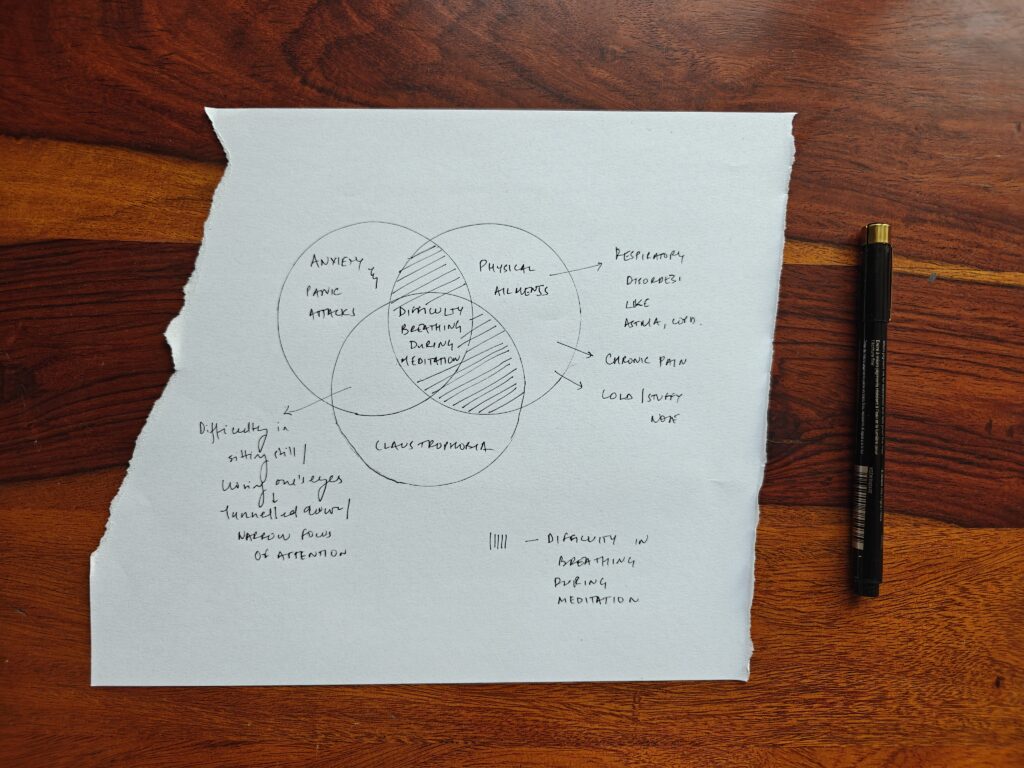
Many people write off mindfulness because they experience difficulty in breathing during meditation. This always breaks my heart because mindfulness can be particularly helpful in case of anxiety, or respiratory disorders like asthma.
Years ago, as a toddler mother, I used to be all over Facebook parenting forums, devouring strategies to parent better by way of avidly reading the comment section of posts that described situations I had experienced myself. On one such ordinary post, by a mother who felt guilty when she yelled at her child, I saw a comment that stopped me in my tracks,
“I wear a rubber band on my wrist. Every time I yell at my child, I snap it hard until it stings!”
A few replies later, she nonchalantly explained,
“This is how I teach myself to pause before reacting. Mindfulness is out because I can’t meditate due to anxiety.”
I was deeply moved by this mother’s commitment to being a good parent, but even then, early on in my own motherhood journey, I knew that being harsh towards herself was not a good investment in the journey of parenthood, which after all, is a lifetime commitment to connection with your child.
I felt particularly helpless because the idea that a person who suffers from anxiety cannot meditate is a deeply pervasive one. On further questioning, the explanation usually boils down to one of these three things — difficulty in focusing on the breath, claustrophobia when they close their eyes, or restlessness when they sit to meditate.
That first reason definitely set a light bulb off for me. As an asthmatic, I have had several episodes, spanning weeks, where I struggle to breathe. Meditation feels out of reach at times like this, and frustratingly so, because although my asthma attacks are usually triggered by a viral infection, there is always an emotional overlay. Mindfulness meditation is a wonderful adjunct to medication during my attacks, but focusing on the breath is out of question when breathing itself causes distress.
In this article we will look at how people who experience difficulty in breathing during meditation can still practise mindfulness. We will also explore feeling anxious, claustrophobic, or panicky during meditation, and what we can do to practice mindfulness with ease.
Breath as an Anchor in Mindfulness Meditation: Observation, Not Control
All mindfulness practices begin with us choosing an anchor — a place for us to rest our attention for the duration of the practice. It is also the place we return our attention to, over and over again, when we get distracted, or lost in thoughts during practice.
The most well-known anchor is the breath. A person seated cross-legged, their eyes closed, focusing on the breath is the most common image that arises when you say the word ‘meditation.’
There is a caveat here though:
In mindfulness meditation, one is meant to OBSERVE one’s breath — not alter it. There is a practice that involves controlling or manipulating the flow of breath to alter blood biochemistry — this practice is called breathwork. Like mindfulness, it can be a potent tool for inner work and even spiritual practice — but the actual procedure (aka how one performs or practises breathwork) is NOT the same as breath-focused mindfulness meditation.
Unfortunately, because both practices involve the breath, they are often conflated with each other. From a practical point of view, breathwork requires greater consideration of a person’s physical and mental health before and during practice than mindfulness does.
This does not mean that mindfulness does not need modification or caution in certain situations. It absolutely does — but it is essential to grasp first the distinction between mindfulness and breathwork.
Ironically, as human beings, we find it very hard to pay attention to something without trying to fix or change it! So often, in the early stages of mindfulness practice, or even during stressful situations, you may find yourself trying to control your breathing — breathing faster or slower, or breathing in deeper, instead of paying attention to the quality and flow of breath.
The fix is simple — when you notice yourself trying to control or change your breathing instead of just observing it, acknowledge what’s happening and return to pure observation. This, however, is easier said than done. And even harder under the circumstances we are discussing in this article — respiratory disorders and physical illness, anxiety, panic, and claustrophobia.
How to Practise Mindfulness When You Have Difficulty Breathing Due to a Physical Ailment
Asthma isn’t the only medical condition that can get in the way of breath-focused meditation — any respiratory illness can. I find it hard to meditate when I have a cold, and my nose is stuffy or running!
Similarly, any condition that causes pain — at rest, during movement, or during breathing — would make focusing on one’s breath hard, if not impossible.
On the other hand, physicians have finally accepted what science has long established (and common sense ALWAYS said) — that our physical health influences our mental health and emotional status, and vice versa. Which makes mindfulness a particularly helpful tool when you’re ill, but only if breath-focused meditation isn’t the only way to practise mindfulness.
Fortunately, it isn’t!
However, choosing an anchor like internal body sensations or body movements may not be feasible either during periods of ill health and physical discomfort. In these situations I find that focusing on sensory input can really help. The information we take in from our surroundings, through our five senses, can be a wonderful way to stay present without focusing on what’s unpleasant or distressful.
It can further help to create a toolkit that holds objects — pre-selected by you — that provide pleasant or soothing sensory input. In my pre-recorded workshop called Create Your Own Calm-In-A-Box, I help you to put together a tangible sensory toolkit based on principles of mindfulness. While the intent of the workshop is to create this toolkit as an anxiety relief resource for moments of overwhelming anxiety, it can also serve you beautifully when you are unwell but need to access mindfulness.
If movement-based mindfulness in the form of walking meditation is out of the question within the constraints of your illness, it may still be possible to engage in alternate movement-based mindfulness practices such as your own mindfulness rituals, or the Art of Mindfulness Practice I have developed.
You can also learn to work specifically with the emotional overlay of your health situation. I have developed a specific framework for this sort of emotional inner work called The Guesthouse Approach, that teaches you to engage with your emotions in a conversational manner.
In brief, this approach involves constructing an imaginary setting where one can safely ‘meet’ and engage with one’s emotions. It allows for personification of, and dialogue with, the emotions themselves (or the parts of you that are most intensely preoccupied with the emotions), so you can uncover the message that emotion carries in your specific situation. In this way, it becomes possible to meet your own emotional needs in a healthy and appropriate manner.
As this is a step-wise and very specific way to approach emotional inner work, I’ve dedicated a separate article to explain it in a detailed and reproducible manner.
Finally, I have found the phenomenon of pendulation to be very helpful to access mindfulness during physical distress— especially in cases of hospital-induced anxiety, or illness. As the name suggests, it involves switching one’s attention from a neutral or even pleasant area in one’s body, to the area of pain or discomfort, and toggling back and forth between the two. It is a practice that helps us to widen our zone of tolerance in the face of unavoidable physical discomfort.
Can You Meditate with Anxiety or Panic Attacks?
Anxiety and Mindfulness
Anxiety is just an emotion, like so many others, but it receives a disproportionate amount of airtime for two reasons — it is very prevalent in our modern times, and justifiably so. Health anxiety, eco-anxiety, and financial anxiety are specific forms of anxiety that many of us experience like a pervasive miasma hanging over us.
The second reason is that anxiety, as an emotion, is very overwhelming, involving the flight state of our sympathetic nervous system. In fact, panic attacks hijack the nervous system, making it very difficult to make sense of a situation or take action. Rational decision making, and taking action often help with anxiety and panic, but are, ironically, inaccessible in such situations.
Many people who’ve experienced this sort of anxiety have visceral memories of difficulty in breathing, which feeds the anxiety further, since breath is literally our lifeline, but feels cut off in the moment.
Both anxiety itself, and our bodies’ response to it, are wise and protective mechanisms, even though the experience itself is extremely uncomfortable and even distressing. Like all emotions, anxiety too has a message to offer us, generally one that is meant to guard and protect us in some way.
Anxiety is like an alarm going off, or a very alert dog barking in the garden, signalling the presence of an intruder. The rush of sympathetic hormones like adrenaline leads to faster breathing, and that is meant to help our bodies have access to greater amounts of oxygen in a moment of crisis.
Mindfulness-Based Approaches During An Episode of Anxiety
While these explanations can put anxiety in perspective and reduce shame, they don’t take away from the terror of the actual experience. As I already mentioned, access to rationality is blocked during anxiety or a panic attack. Meditating during an acute attack of anxiety is not a feasible, or reasonable option for most people.
Instead, it helps to have a pre-prepared anxiety relief toolkit that can help us to soothe, take the edge off the anxiety, and return to the present moment. Once the excess ‘flight’ energy of anxiety is siphoned off, it is possible to use The Guesthouse Approach to access the wisdom of anxiety, and access logical thinking as well as compassion and discernment to take clear action in the face of threat.
Mindfulness For People With Anxiety (Outside of an Acute Episode)
We’ve already touched upon the fact that any people who have experienced acute anxiety have a visceral memory of their past experience. For some of them, they may not be able to practise breath-focused meditation at all, as any attempt to pay attention to their breath can bring up past experiences of anxiety and panic. It can be quite hard, if not impossible to rationalise, or overcome a flashback of such a bodily experience. For anyone with this kind of traumatic recall of past anxiety, forcing themselves to practice breath-focused meditation could be counter productive at best, and even harmful.
Additional support in the form of 1:1 guided meditation, with a trained facilitator tracking their nervous system, and available to provide external regulation may be helpful. But such support is neither easily available, nor always feasible.
In any case, sensory and movement-based practices would be useful to a person who struggles with anxiety, allowing them to use mindfulness to help manage their anxiety, instead of breath-focused meditation triggering an episode of panic. Walking meditation can be particularly helpful to move that sympathetic surge (which may be higher at baseline) through the body.
It is also important to note that not all people who suffer from anxiety will be unable to meditate, or focus on one’s breath. If your experience of anxiety is not one of acute episodes or panic attacks, it is worth attempting breath-focused meditation, and even body scans when one is in a good headspace. The modifications mentioned below may help as well.
Nevertheless, one should never attempt to over-ride one’s bodily signals or discomfort – maintaining a sense of agency over one’s body and mode of practice is important. I would also like to point out that the ability to focus on one’s breath when one is feeling okay doesn’t mean it will always be able to do so. My own ability to practice breath-focused meditation fluctuates from season to season, and depends on my physical health and emotional status, but I am always able to access some form of mindfulness. These articles are my attempt to help you do so too.
How to Meditate When You Have Claustrophobia
I included this section in this article because claustrophobia is closely related to anxiety and panic attacks, and also because I find that certain aspects of meditation — closing one’s eyes, narrowing focus to a single anchor like the breath — can induce a sense of anxiety for those who are claustrophobic.
Hence, much of what I have mentioned in this article also applies to those who suffer from claustrophobia, but would like to find ways to practise mindfulness.
Once again, mindfulness practices that use movement or sensation — like walking meditation and the five senses practice — may work very well for people with claustrophobia.
In the case of practices like breath-focused meditation and body scans, it may help to keep one’s eyes open and the gaze softened, while looking at a neutral point in the distance. This allows input from the periphery to register in soft focus, cutting visual distraction while expanding the field of vision and preventing the tunnel effect that can induce the sensation of claustrophobia.
Between the two practices, the body scan may suit some people better, as it involves allowing one’s attention to travel across the body, naming and feeling into the internal body experience — the sensations present in each part.
Even with breath-focused mindfulness, it can help to focus on the flow of air in and out of the body instead of picking a static point like the nose to focus on.
Mindfulness Is Not Out: Finding Your Way Back to Practice
I think of the rubber band mother often — I wrote this article for people like her — so that conscientious people who care about their relationships and value connection with their loved ones don’t think that snapping a rubber band against their wrist is the only solution to staying present.
Mindfulness is not ‘out’ if you, or a loved one, suffers from anxiety or respiratory ailments. Instead, there are several ways to modify the steps of meditation that can help it ‘work.’ There are also various mindfulness practices that do not focus on the breath at all.
It is always advisable to do any mindfulness practice at the pace and in the form that suits you, without trying to force oneself or push one’s limits. It goes without saying that in the case of physical ailments that affect breathing, it is important to seek the advice of a doctor and take medications as required. Sometimes it’s less obvious (or feels more stigmatising) to seek professional help for anxiety, panic, or phobias — but it is just as essential.
Mindfulness calls on us to pay attention to distress and suffering, and to use discernment and self-compassion to alleviate it as best we can. Seeking counselling, therapy, or medication is a part of caring for ourselves, and can be approached mindfully.
This post is part of a series on why mindfulness and meditation doesn’t work for everyone — and what to do about it.


One Comment