If you’re feeling hollow, dissatisfied or restless, even though you’re life looks good on paper…
If you’ve worked towards and even achieved a measure of success, but you catch yourself wondering, ‘Is this all there is to life?’…
…this is NOT a sign that there is something wrong with you.
It is an invitation to step into a bigger story, and to locate yourself in the long arc of humanity.
Written by Nimisha Kantharia. Published 5th February 2026.
IN OTHER WORDS:
This world needs good future ancestors and you are being called to be one. The true purpose of a human life is way larger than the lie of personal ambition and individual achievement that we’ve been sold.
This essay will help you process the feelings you have about living in today’s fast-paced, materialistic world, and why doing all the ‘right things’ doesn’t help.
And:
It will provide you with a framework that helps you expand your capacity to live a larger, more meaningful life, joyfully.
The world we live in runs on a shitty OS. This is not a bug, it’s a feature – the system is flawed by design.
Most of us know that patriarchy, capitalism, racism/casteism/classism are inherently exploitative – that they all function on the underlying principle of false hierarchy, where the ‘strong’ have power over and dominate the weaker and marginalised sections of society.
These are the forces that have shaped the world we live in. But they are not just historical entities – they continue to be active forces that pretty much run the world even today.
Most of us are aware of these -isms. But we ignore their continued existence for two main reasons.
1. It feels as though they don’t REALLY affect our day to day life – that patriarchy is what happens in countries where women can’t drive their own car or go outside without a male chaperone, that racism and casteism was a last century problem. We may even believe that capitalism is a good thing.
2. The systems are so huge in scale, so all encompassing, so insidious even – that even when we accept that they are exploitative, we don’t know what we, as individuals, can do about them. So we just ignore them as best we can, and go about our daily lives.
The truth is:
As individuals born and raised in this world, we too are shaped by these very systems of oppression in both subtle and obvious ways. This is what we call societal conditioning, and it is not possible for any of us to ‘escape’ this conditioning by ignoring it, or by wishing it away.
These systems create a false scarcity and force the majority of the world’s population to compete for ostensibly limited resources. Most of the world’s problems are man-made, engineered by the few to keep the majority of humankind expending precious and limited time and energy struggling to survive.
Right now, the disparity between the so-called ‘haves’ and ‘have-nots’ is reaching absurd levels. You may have heard that Elon Musk is set to become the world’s first trillionaire. And, if you are like me, and can’t grasp the concept of these numbers with names (million, billion, trillion) let me tell you a statistic that helped to put it in perspective for me:
If you spent 1 million dollars per day, PER DAY mind you, it would take you 2700 years to finish spending 1 trillion dollars.
2700 years! Let that sink in.
2700 years is your grandchildren 30 times removed. Do you know the names of your ancestors from 30 generations ago? I don’t!
I did some more digging and found out that in 2024, the 32 countries that make up NATO contributed a combined 1.45 trillion USD to military defense systems. Which told me that a trillion USD is already in circulation, with the caveat that this is 32 countries contributing the sum versus one man’s net worth.
This was also when I found out that the UN estimates that it would cost about 90 million USD/year to end world hunger.
So…
If we kept aside just, just 1 trillion USD from the NATO budget for just one year, AND spent 90 million USD each year on ending world hunger, it would take 1,111 years to exhaust the 1 trillion we had kept aside.
Under one year of the NATO’s defense expenditure is the equivalent of 1,111 years without a single baby dying of hunger, without a single child stunted by malnutrition, without a single mother delivering undernourished infants.
Shocking as these numbers are, you may be wondering what it has to do with you and me. After all, we don’t own a trillion or even a million dollars, and we have no power to direct NATO budgets, right? We are among those who have, by birth, good fortune, hard-work, or a combination of the three, managed to escape survival mode and lead a decent, comfortable life that we have worked towards.
And yet…
A large part of the work we do, the value we generate in our workplaces goes towards lining the pockets of corporations and wealthy entities and businessmen.
Consider how much of Elon Musk’s wealth is derived from the value created by the people who work for him – from the factory workers and engineers, to sales executives and office staff.
And so… …we are sold the lie of personal ambition – work harder, rise higher. A lie that is compelling because that promotion does after all come with extra income, tangible cold hard cash that we can spend on good schooling for our children, better housing, maybe two vacations a year, and more crucially – a safety net in case of accidents or ill health.
To be clear…
There isn’t anything wrong with working hard, with wanting a better life for ourselves and our loved ones.
But the larger reality is that even as we work at these jobs that help us to make a living and provide for ourselves and our families, we are also cogs in the wheel- dispensable, replaceable parts of the machinery that upholds the exploitative systems that run the world.
And these systems manufacture a scarcity that keeps us ever more focused on personal/familial security, while selling the dream of ‘hard won success’, the ‘self-made man’, the ‘woman who broke glass ceilings.’
It is no wonder then that so many of us feel hollow inside, or restless, despite our so-called ‘success.’
So you may be wondering…
What is this essay about?
In this essay we will be covering three inter-related key concepts about living full and joyful lives as human beings who exist in a world run by exploitative systems, and what we can actually do, as individuals, about this mess we find the world in.
Who is this essay for?
Those who care deeply about doing their best at work, and by their loved ones, yet find that the path they have followed so far doesn’t feel as fulfilling as it should.
And for those who try hard to make a difference and do good, but find themselves constantly exhausted and overwhelmed.
This includes but isn’t limited to parents, teachers, professionals, coaches, corporate executives and creatives.
KEY CONCEPT #1 – You matter (and it doesn’t mean what you think it does)
In this section we will explore what “You matter.’ means – both the qualities of ‘mattering’ and the implications.
Let’s start with a thought experiment…
I invite you to think of a human being that is very dear to you. If you are a parent this would likely be one or more of your children; if you’re not a parent, this person may be a child you know, or it may be a truly lovely adult in your life.
Whoever they are, spend a few moments thinking of this person. You can even close your eyes, and bring up an image of them in your mind.
Focus on what they look like – those features so dear to you – the way their eyes light up when they smile, how their hair flies across their face or flops on their forehead, how they sound when they speak, or laugh, or sing, what they do that makes you feel such warmth towards them.
Think of how it feels to be in their presence. Really and truly, what does it feel like to realise that they exist, that you know them, that they are a part of your life? Think for a moment what life would be like if they didn’t exist.
They’re unique and irreplaceable, aren’t they? So, wouldn’t it be logical to say that.…
IF they are special, irreplaceable, all kinds of wonderful, THEN you are too?
Friend, you are unique.
Think of how remote the mathematical probability is that you exist – you as a unique person – composed of blocks of organic matter, arranged in a particular order, directed by your unique genetic code.
Can you imagine how many of your ancestors had to meet and mate – just for you to exist? And even once they did, can you calculate the odds of that particular sperm fertilizing that particular egg, forming an embryo that survived in your mother’s womb to be born as you?
For context :
A woman has 300,000-400,000 eggs when she reaches puberty. And on an average there 15 million to 200 million sperm in 1 milliliter of semen.
Which means the odds of YOU existing are staggeringly small.
There is no one quite like you – who looks like you AND thinks like you AND has experienced every single thing that you have, and has made the same meaning out of the life you have lived.
You may share features with your family, and personality quirks with your friends, you may share degrees, hobbies and job profiles with many many others, but you are still unique.
You are a one-of-a-kind human being – just like your dearly beloved person. And as you are, as they are, so is every single human being that ever existed on Planet earth.
It may be a stretch to imagine, but it is the only logical conclusion we can draw.
But now, let’s take a look at what it actually – tangibly and practically – means when we accept that every single human being ‘matters.’
Once again bring up that special person of yours in the forefront of your mind, and heart. This time, reflect…
What do you wish for them? What do you want for them?
All that is good and nothing bad ever, right?
If I could put words in your mouth, you’d want them to always be happy, to stay healthy, and be safe, to know and remember that they are deeply loved and cherished.
In short, you wish that all their physical and emotional needs are always met.
And this, my friend, is what it means to matter – having your intrinsic needs as a human being met and fulfilled… no matter what.
Again, logic says you, too, deserve the same thing – you deserve to have your every need met, and to experience joy and freedom and love.
And when we expand that circle of logic – so does every single human being on earth.
But this is harder to accept. So let’s examine WHY you think your dearly beloved human being matters in the first place.
Now, I’m willing to believe that they truly are a good person, that they radiate warmth, that they’re kind.
But is this the main or only reason that they deserve happiness and all good things in life?
If you’re thinking ‘Yes! They are so good, they deserve ALL THE GOOD THINGS.’ I would encourage you to dig deeper.
Because…
If a person, any person – your loved one, you, a famous do-gooder – is worthy or deserving ONLY BECAUSE they are good, then that is conditional worthiness.
Which is sort of an oxymoron.
Many of us are indeed conditioned to see ourselves, loved ones, and this world at large through this lens of conditional deservingness.
And it puts us in this position where we end up constantly evaluating whether or not we and others are being good enough, useful enough, kind or helpful enough to deserve goodness, kindness, and help in return.
But that person you care for deeply…
… are they ALWAYS good/kind/helpful ALL the time with EVERYONE – no exceptions?
If you think about it, it is impossible for anyone to ALWAYS be good and true and kind. It is an unreasonable standard to hold ANY human being to, right?
So if your loved one is sometimes wrong, grumpy, rude, makes mistakes or loses their temper and is STILL worthy and deserving of all goodness and happiness… then this MUST mean that deserving to have one’s needs met DOES NOT depend on behavior, personality, or emotional state.
Which, in turn, means that every single human being is inherently worthy of having their intrinsic needs met. No matter what welike/dislike/think about them, or where they come from, and what they do.
Here’s another way of looking at the same issue:
Human beings are coded with a deep desire to matter. And, when we are raised in an exploitative world, the systems teach us to look for evidence we matter outside of us, in the jobs we do, in the comfort we offer others, in our usefulness or achievements or some specific quality that we possess.
Consider your workplace. There are certain things you do that are a part of your job and when you are absent from work, it probably causes inconvenience to your team-mates. Even in our homes, and this is especially true for a lot of women, there are certain chores we do, in a certain way that contributes to the comfort of everyone who lives in that house. If you were to fall ill, your chores would fall on others, or even stay undone until you recover.
We tend to assume that the inconvenience caused by our absence is evidence that we matter. We may feel guilt for causing this inconvenience – but beneath this guilt, lies the so-called proof of our ‘mattering’ aka our worthiness to receive.
And yet, job layoffs happen every single day. And when a person retires or resigns, they are replaced.
If we predicate our right to have our needs met on external metrics like usefulness, and good behaviour – we are going to fall short of the brief many, many times in our lives.
And to further underscore this point, let’s consider the human newborn- that most helpless of creatures, who is utterly dependent on the adults around him, and does nothing useful, helpful or productive in material terms.
None of us would deny that every newborn deserves to be fed, and swaddled and kept warm and comfortable, and be attended to when they cry. And yet the child has done nothing to justify the care and concern that we show towards them.
All of us have been this utterly dependent newborn at the beginning of our lives. And other human beings have met many of our physical needs and some, if not all, of our emotional needs for us to have survived to adulthood.
It can be very disconcerting to imagine one’s self as a helpless infant; the idea of being so utterly dependent on the good will of others can be uncomfortable, even abhorrent.
So we shove the thought aside before it can even form in our minds.
But so much of our ‘drive’ to work and earn is either to ‘prove’ our worthiness of having our needs met, or to ‘safe guard’ against future dependency. Some common examples are setting up a retirement fund, or the middle-aged fitspo slogan of ‘When I’m 80, I don’t want to be a burden.’
To be clear, I am not saying exercising or investing is a bad thing; I’m not maligning foresight or attempts to secure your future.
What I am asking is for us to accept the fact that the mere idea of dependency or vulnerability is intolerable to most of us. And lies at the root of much of the routine, even ‘sensible,’ things we do and take for granted.
And yet, at any moment, we may be reduced to utter dependency by fate and the mere throw of the dice – an accident, an illness, a stock market crash, or financial fraud perpetrated on us.
Our past vulnerability, or potential future dependency is not the reason why we should include everyone in this circle of humanity – it is merely the doorway through which we enter the circle of humanity ourselves.
The truth is NO human being should have to do anything in order to DESERVE basic human dignity. Every single human being – poor or rich, ill or healthy, weak, strong, young, old, of every culture, religion and country – deserves to have their basic needs – both physical and emotional – met and fulfilled.
But…
…and now the reality check…
.. we KNOW this isn’t true for many, many (most? all?) human beings. There is deep and grievous suffering in this world, unfairness of all kinds, unfathomable sorrow.
And this is due to the BAD operating systems running the world. (Like a child would say it, only the word BAD seems to encompass the true depth of the horrors perpetuated by patriarchy + the -isms.)
So we can – and MUST- hold two seemingly opposing truths at the same time:
Every single human is unique, and worthy of having all their needs met AND the world functions on systems that DO NOT recognise this.
The ‘cure world hunger’ statistic from earlier in this essay shows us how artificial scarcity is, and how lack is a distribution problem, at best, and at worst, it boils down to sheer depraved greed.
Which begs the question – what can we, as individuals, who need to work to survive and provide for our own families, DO about all of this? Well…
Start by accepting that though the system treats you as a dispensable, replaceable cog in the wheel that runs the world, you are, in fact, NOT A COG – you are a beautiful, one-of-a kind piece in the wonderful puzzle of human existence. (And if you have ever done one of those ginormous jigsaw puzzles made of a gazillion teeny tiny pieces, you’ll know that the picture is incomplete if even one piece goes missing!)
Next, accept that you are intrinsically worthy of having your basic and inherent human needs met. And so is everyone else. Even if the world isn’t structured to provide for everyone’s needs.
And once you accept these, we can move on to the next concept.
KEY CONCEPT #2 – Your personal liberation is inextricably intertwined with collective liberation
(aka none of us are truly free until all of us are free.)
As human beings, we have an innate drive to grow and evolve. We already touched upon how exploitative systems have coopted this drive and narrowed its scope to personal ambition and individual success. This is something which contributes to life feeling uncomfortably smaller than it should. So let’s widen the scope a bit.
[For the purpose of this essay, I have used the word personal liberation as an umbrella term that includes healing, integration and wholeness, and even transcendence/enlightenment.]
Let’s start with the simplest premise…
Each of us, though we are a single individual, we are also comprised of a multitude of parts, or facets. In that thought experiment involving the person you love dearly, we looked at how they are largely kind, and good, but also make mistakes, and have an off day. They have multiple facets to them, as a human, and you, as someone who loves them dearly, are able to accept them wholly – warts and all. Which is a wonderful thing.
Similarly, we too are not monoliths, but instead have different aspects to us. The clearest example I can give is how you are different at home versus at work, different with colleagues than with friends – even in social settings, and may even be different with school versus college friends. They all see and know a different aspect of you. I would go so far as to say they bring forth a different part of your personality, sometimes one that is so significantly different it causes you or them some discomfort when different social groups mix.
Now all of this is perfectly normal. The only reason I belaboured the point is to offer you the opportunity to recognise that you, me, all of us have different ‘parts.’ We also have characteristics of us that we lead with, and others – including, thoughts, feelings, behaviour – that we are
ashamed of, or find inconvenient, and these aspects we try to hide away, even from ourselves. In simple words, we suppress these aspects of ourselves from our conscious thinking. But even beneath the surface they influence how we show up in the world.
This then is the work of healing and integration – to assimilate all the parts of us – even the ones we are ashamed of and would rather not deal with. Because all our different aspects carry strengths and gifts, and it takes a significant amount of energy to keep them out of our conscious mind. As we heal and process and integrate, we move towards wholeness, to becoming more fully human.
To be clear, this is the work of a lifetime. It is the B-story of human existence, the one running behind and even shaping the scenes of our conscious life. Unfortunately it is also very easy to avoid doing this inner work, and that is partly (largely!) down to the systems that make us struggle to survive, and re-package our drive for inner growth and evolution as ambition and success.
Nevertheless, as we have access to more of ourselves, and more energy, this itself can alleviate some (usually not all) of that numbness/hollowness/restlessness that accompanies modern life.
At this point, I would like to point out that just as we, as individual human beings, are made up of different parts or aspects, so also is society, this world we live in, made of all sorts of different people – rich, poor, healthy, ill, disabled, creative, and so on – not to mention different genders, ethnicities, personalities.
And if you remember our metaphor from Key Concept #1- you, me and each and every one of these people – are a piece of the same enormous existential puzzle – a picture that would be incomplete unless all of its pieces were fitted together.
If we accept this, it is not such a stretch to accept that your personal liberation – a movement towards the fullness of your humanity – leads to, and is dependent on collective liberation – a movement towards a more whole society, one that has place for, and even centres, the most vulnerable, needy and dependant.
For…
…unless we accept all parts of us – and this includes all our needs, our vulnerability, the things we are ashamed of – how can we possibly accept the sections of society that are marginalised and vulnerable?
And it is only to the extent that we accept the different factions of society -including those we want to judge like the homeless person who ‘should just go get a job,’ or the addict who ‘made bad choices,’ among others – that we expand our own capacity to accept what we have in common with them.
Most often our judgement of another person’s needs, or the vulnerability of a section of society, hides our own fear of what we have in common with them. And radical acceptance is the way to both personal healing and collective healing.
However, radical acceptance does not mean permission to behave badly, and it will help to look at how this applies at different levels.
Radical acceptance of one’s self and all of one’s parts means that we do the inner work of processing our experiences, and the emotions they bring; it means understanding that our urge to behave in certain ways arises from difficult experiences and the accompanying big emotions BUT that does not mean it is ok for us to act in hurtful, or even harmful ways. On the contrary, radical acceptance encourages us to take responsibility when we have caused harm, and initiate repair where our behaviour has led to a rupture in a relationship.
Conversely, radical acceptance of another human being in your life merely means that you understand that they, too, are a conglomeration of good and not-so-good parts, that they are in some ways easy to be with and in others, they are hard to tolerate. And it means holding the other person gently yet firmly accountable for their behaviour towards you. It does include setting boundaries where necessary; radical acceptance is not an excuse for tolerating bad behaviour from others.
Radical acceptance looks very different at the societal level than between two human beings, and this is precisely because of the bad OS that is running the show. For example, it is easy to apply the concept of boundaries that should operate in a healthy relationship between two human beings to the idea of boundaries between countries, and declare some human beings as ‘illegal immigrants’ who break the law. But in this situation, radical acceptance of immigrants and their right to safety, to having their physical needs met means we examine and question a society that declares a human being ‘illegal.’
So the same principle of radical acceptance looks different when applied to different scales. And it takes discernment to understand this.
Having clarified that, the tools for personal liberation have always been a part of the human story. Consider the fact that there are so many religions, and spiritual traditions. To me, they have always seemed like evidence – not necessarily of the existence of God, or a higher power that governs the world – but of the intrinsic human longing for a story that is bigger than ourselves. Within religion, and spiritual traditions, lie many tools and ways through which a human being can move towards wholeness and healing.
Unfortunately, the mere invocation of god, or a benevolent higher authority, is not sufficient to prevent the corruption of these tools by the very same systems that run the world. Institutional religions around the world are hot-beds, even fonts and van-guards of patriarchy. Spirituality, in its many guises, offers an opportunity to ‘escape’ from the travails of this world, leading to dissociation instead of transcendence.
It is no wonder that many of us are disillusioned by these traditional sources of healing wisdom, or only engage with them in a limited capacity.
On my part, for a long time, I found it easier to engage with tools that arise from religion/spirituality but are stripped off their patriarchal, racist, classist and casteist overtones. I am talking about the personal development industry here – one that arose to meet this same human longing for growth and evolution as religion/spirituality did, and took tools, practices and rituals from there and secularized them, and in some instances, even gave them scientific backing to make them more acceptable in today’s era.
However, just like religion and spirituality have been co-opted by systemic forces, so too has the personal development space. The problem arises when our longings are turned against us by personal development tools that should lead to personal and collective liberation but are instead oriented for productivity and efficiency – thereby turning us into better cogs in the wheel.
Let me explain with an example.
Mindfulness originated as the path to enlightenment through acceptance and endurance of human suffering. But it was co-opted by corporate culture and now meditation is used as a tool to ‘increase focus,’ so that you can get more work done in less time. Art (read : mandala coloring books and the like) is used as a way to relax from the stress of an unrelenting workload every evening so that you can go back to the same thankless work the next day. Gratitude journaling turns into a way to stay positive in the face of hardships instead of interrogating the source of man made and unnecessary suffering.
Again…
if you use and are helped by any of these tools, this is not a criticism of you, or of the tools themselves. As you will see later in this essay I use them too. My criticism here is about how they have been hijacked by exploitative world structures and deployed against the people they are meant to help.
To sum it up:
Systems treat human beings as dispensable and replaceable cogs in the wheel that prop up the systems that benefit only the powerful. At the same time, our intrinsic human desire to grow and create impact is packaged as ambition, while personal development strategies are leveraged to help us, the cogs, endure our lives, instead of escaping from and questioning these systems. There’s nothing wrong with tools, practices, processes and rituals themselves – the problem arises when they are positioned in ways that promote individualism, recruiting our natural human drive for betterment to prop up a hierarchical, exploitative world.
I find the metaphor of a candle very helpful when considering the link between personal and collective liberation.
Think of the work that you do to heal yourself and become more whole as lighting a candle- your inner spark if you will.
Now if we lived in a different sort of world – not a perfect idealised utopia, just one that wasn’t so power dominant and exploitative, your inner work would be like the rising tide that lifts up those around you… …the light of your one solitary candle could light up many others, creating a warm glow, without in any way diminishing the potency of your original flame.
But because we live in a world with a shitty OS, our personal liberation work is akin to lighting a candle in a small box.
Not only is the boxed in candle unable to share its spark, but it is likely to use up all the oxygen in the box, and snuff out. Which is an accurate, if harsh, metaphor for the implications of personal liberation work that is divorced from the collective.

This is why it is very important that we deliberately and intentionally do our inner work – whether this is in the religious, spiritual or personal development space, or all three – with the intention of serving the cause of collective liberation.
This does not mean I am asking you to quit your job, and become an activist. Shitty OS notwithstanding, you do still have to earn a living, and/or provide for your family, and hey! maybe you even love your job, and find it fulfilling.
Friend, nothing I have said so far is a call to throw away your current life. What I’m asking for is far more subtle and dare, I say, foundational to changing this world. It is a call to engage with this world, your work, your life, and your relationships, even the one with yourself, with thoughtfulness and intention.
It is a call to work on your personal liberation with such depth and tenderness that you find your own place in the arc of collective liberation. After all, we have established that you are unique – in your perspectives, experiences and skills – so naturally the work of collective liberation also requires you to occupy a unique role – one suited to your nature, that plays to your strengths.
Discovering what exactly this role is is your task, and it is very likely that this role will look different at different times in your life.
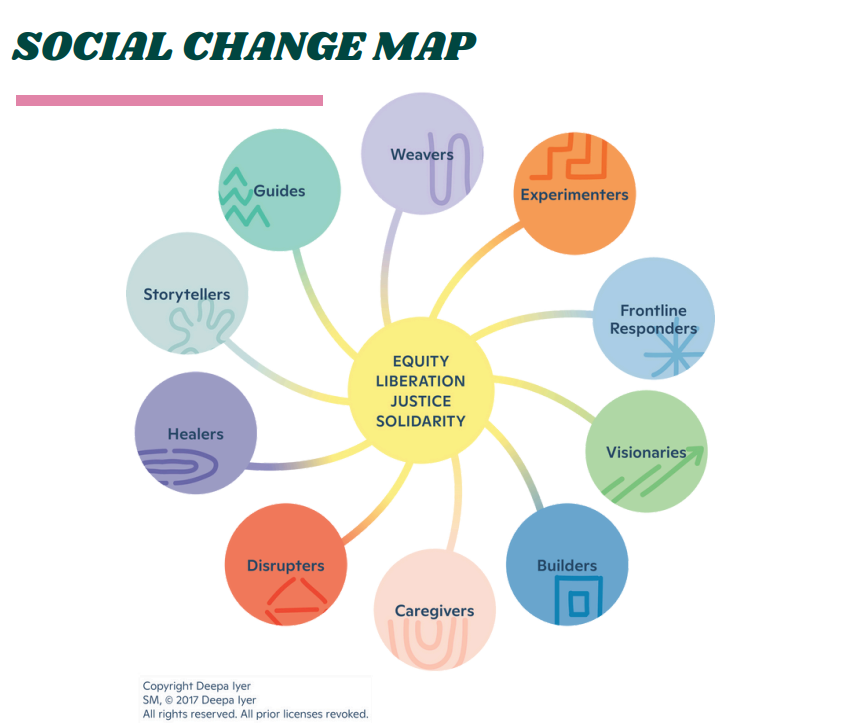
Deepa Iyer, author of Social Change Now – proposes an eco-system approach to the various roles we can inhabit in this journey towards collective liberation.
You may be a story-teller, or a weaver, a visionary or a builder, a care-giver, a disruptor, a healer, an experimenter, a front line responder.
You may primarily inhabit one of these roles, but also bits of others.
At one point, you may be a frontline responder, but that role may shift to care-giver if you find yourself having children, or elderly or ill family/friends to care for.
But stepping out of society sanctioned labels – office-worker, teacher, doctor- and enlarging our identities – parent, wife, friend – into roles that can move and eventually change systems, is part of the story of how we can combat that hollow restlessness that plagues us even when we are successful.
This is the work of stepping into the bigger life we are called to as humans.
Later in this essay. I will offer you a framework that will both help you to expand your capacity to do this work, and to discern what direction it may take for you
There’s one more thing to keep in mind as we do this work and that is…
Living in the paradigm of an exploitative society, we have to remember that we are also conditioned by the powerful systems that shape our society. This means that any effective personal liberation work MUST include the work of deconditioning from the systems that govern the world. We must question hierarchy, power over, domination in all aspects of our own life – whether that is in the realm of parenting, or at our work place, or in how we treat service personnel like cleaners and waiters.
Also, in this paradigm of an exploitative world, working towards collective liberation MUST include dismantling the systems of hierarchy and domination. And we can only dismantle the systems if we decondition from them enough to question them.
This work isn’t easy – and it can be tempting to think that the systems are too large for us to dismantle. And this is most certainly true. But we were not meant to dismantle the systems alone – it is a collective endeavor, and one that spans across time (something that we will explore more in key concept 3).
But the only way to dismantle a huge piece of machinery is one nut, one bolt, one gear at a time. And so it is with the systems that keep us all trapped – we shift them little by little, and we work together.
Before we move on to Key Concept 3 – the z axis, also called the long arc of the human story, I do want to tie together the first two concepts we have studied.
From Key Concept 1, you remember that you matter – you deserve to have all of your needs met. I want to reiterate here that Key concept 1 does not depend on Key concept 2 – that is to say, you do not need to do the work outlined here in order to earn your worthiness. You are worthy of dignity by virtue of your status as a human.
This concept can be a hard pill to swallow if we include those who have committed heinous acts like say Hitler, or a serial killer, or abuser. But even stretched to its limit, all that Key concept 1 means is that even the most evil human being deserves to have their basic needs met as we conduct due process and hold them accountable for their crimes.
And I dare say, if many of them had more of their physical and emotional needs met in their early formative years they would not perhaps have turned out the way they did.(Please note the use of perhaps – I can only speculate, not prove beyond reasonable doubt, that children who have all of their needs met will NOT turn into heinous adults, because we still have to contend with the bad OS.) I have stretched the concept to this limit precisely to show you, that you, and me and ordinary people like us who are a mix of good and flawed, do not have to do anything to deserve basic human dignity.
Nevertheless the systems that be ensure that many, many humans are stripped of their dignity every single day. What Key Concept 2 says is that when you, a person who is no longer in survival mode, pursue your intrinsic human desire to grow and evolve, then be intentional about offering your personal liberation in service of collective liberation. I would go so far as to say true inner growth and healing MUST involve efforts to decondition and dismantle the systems of oppression.
But though this is hard work, it need not be lonely nor grim. In Key concept 3 we will look at how even in hard times, and even when we do difficult things, joy can both light up our path and fuel our journey.
KEY CONCEPT #3 – Step in to the long story of humanity to become a good future ancestor (aka Welcome to the z axis)
This probably isn’t news to you, but you weren’t born in a vacuum- you were born into a family from a set of parents, who were born from their respective sets of parents and so on backwards, until you have scores of ‘great’ grandparents, and hundreds and thousands of ancestors.
And even if you do not have children of your own, you still are a future ancestor for generations to come. This is what it means to situate yourself in the long story of human existence, to step into the ‘z’ axis of time.
Every single good thing that exists in the world today – every invention that makes life easier, every philosophy that gives clarity, every attempt at fairness for all, every single personal advantage or opportunity you have – is thanks to men and women, human beings who lived before you did – whether or not they were your biological ancestors.
And it is in this sense that we are future ancestors – because the things we do or don’t, the things we attempt to change, what we create, how we use technology ( cue the AI boom and how we as humans should respond) – all of this impacts the future generations – several future generations.
The Native American Haudenosaunee (Iroquois) tribe hold a philosophy called the Seventh Generation Principle. This principle states that for every action you do, consider the impact it will have on the next seven generations. It is a call to act sustainably and ethically, a principle to guide our present day actions so they may create a better long term impact.
Roman Krznaric, the modern day philosopher, writes in his book, The Good Ancestor, that human beings are the only animals who are known to have the capacity to imagine an as yet unknown future, and to plan projects that cannot be completed in one human life-time. He calls this ‘cathedral thinking,’ a reference to the medieval European cathedrals that were built over a time period spanning centuries.
And so we are all called to steward the future, a call that goes unheard in our current fast-paced times as we live lives that keep us hustling and grinding. And yet this future facing thinking can help us step out of present day urgency. At the same time, looking back at the wise and good people who came before us, reminds us that we are not alone in our endeavors to dismantle systems of oppression.
We stand on the shoulders of giants, and our job isn’t to fix the world once and for all for the generations to come. Our work is to create a firm foundation for the future to stand on, by doing our part, within our sphere of influence, towards collective liberation and a better tomorrow.
I want to emphasize the ‘our part’ bit again – because I know well that guilt at not doing enough, or overwhelm at how huge the problems of the world are, can lead to a sort of paralysis, preventing us from doing our part. But the right action at the right time, and the smallest of steps taken consistently, can bring down behemoths and empires. Especially when we work together. And the long arc reminds us that, even across time itself, we are not alone in our efforts.
The three key concepts represent needs at different levels, with your needs forming the x axis, the collective needs of present times is the y axis, and the z axis represents the needs of the future. In this way, this essay is intended to help you locate yourself on this three dimensional graph of humanity.
This allows us to center our own immediate needs as well as those of our family and loved ones, while also keeping in mind the needs of the collective and future. It allows us to move further along the y and z axes when we are better resourced and have greater capacity.
This way of looking at human life and the entirety of human existence can also help to make life feel more meaningful by inviting us to step into the bigger story (y axis) and long arc ( z axis) of humanity.
However this isn’t just a thought experiment and if we keep these concepts in the realm of thought, it would float away into abstraction. Below I share a framework that has helped me to locate myself on the graph of humanity – a five pointed compass that keeps me oriented while also expanding my capacity to do my part in this story of humanity.
THE SOLUTION – M.A.G.I.C.
In this essay, so far, I have called out religion and spiritual traditions as well as the personal development industry as entities that have been co-opted by the powers that be to enforce false hierarchy and exploitation. In this section, I offer the same tools to be reclaimed and used in service of our personal and collective liberation, as well as future stewardship.
The M.A.G.I.C. framework stands for:
1. M for Mindfulness – We have spoken in this essay about how mindfulness has been coopted as a corporate productivity tool to enhance focus ; Zen is considered to be an aesthetic – muted earthy colors and minimalist plant motifs, and meditation is represented by a cross-legged figure, with closed eyes, and a blissed out smile. The truth is that mindfulness is the gritty practice of being present – an eyes wide open approach to, and acceptance of, the present moment, and our experience of it. And yet this practice (mark that word again!) neither requires one to meditate for hours, nor retreat from life to a monastery or hill-top. Retreat may be the path for some people, and it may benefit most of us to have some time to ourselves, but the beauty of mindfulness is the awareness that spills over from the meditation cushion into daily life, in fact, it is awareness that is woven into the ordinary moments of life – awareness that brings with it acceptance of all that is, and acceptance that is met with compassion.
Mindfulness has been conflated with stress relief and relaxation and is often considered to be a way to ’empty the mind of thoughts. In actuality, it is a somatic practice – rooted in awareness of the breath and the body – and its language of sensation and movement. It is this awareness that expands from the body to include an awareness of our own needs as human beings, our emotions, the stories we carry, and the patterns of our behavior.
And far from the passive miasma that the term ‘non-reactivity’ carries, compassion is the active principle of mindfulness – allowing us to meet ourselves with kindness, and allowing that self-kindness to ripple outward into ever expanding circles of compassion.
Mindfulness is also the basis of emotional intelligence – a way of relating to all emotions as messengers – carriers of vital information, and emotional maturity – a way of processing emotions constructively.
For these reasons, mindfulness is the very foundation of the M.A.G.I.C. framework. Kind awareness is the prerequisite for living a full, meaningful and joyful life across the three axes of humanity.
2. A for Art – Art is an under-rated practice that we assume is reserved for professional artists with inborn talent. This could not be further from the truth. Have you ever watched a child wield a crayon for the first time, the fierce delight of being able to make their mark on a piece of paper, the walls of their home, their world? The earliest human beings made marks on caves with pigments made from earth and stones. And so art is a mark-making tool – one that allows for self-expression and self-discovery, revealing, and even healing truths that exist before and beyond words.
Colors and marks can help us express emotions – even those which feel wild and hard and uncomfortable, turning them into friends with messages of love, care and protection.
Art can also be a wonderful playground to practice discomfort tolerance within the low stakes confines of a page that can be crumpled and torn away. And learning to tolerate our difficult emotions is one of the first steps in knowing and accepting ourselves, as well as in finding the courage to make a change in our lives and the world.
3. G stands for Gratitude and also includes Joy – Unlike the prescriptive practices gratitude is often reduced to, it is actually a powerful force that can help to ground us in difficult times. And the other side of the coin is joy – that fierce sense of aliveness that can both point you towards the work only you are meant to do, as well as fuel your capacity to do it.
This version of gratitude and joy is deeply rooted in mindfulness and below, I offer a free 5 day Incandescent Joy challenge that will help you harness the power of joy.
4. I for Imagination – We already touched upon how the human being is the only animal we know that has this power – the ability to envision the future. When we are stuck in the ‘small’ life, imagination is capped – it keeps us stuck replaying the past- wishing for a better outcome, or worrying about the future. But when we step into the bigger story, the long arc, then Imagination becomes a powerful ally – allowing us to time travel and bring healing to our past selves as well as cast a vision for a more inclusive and brighter future.
5. C for Creativity – This is a way to move through life responding to the aliveness of the current we are immersed in with our full humanity and expression. This way of living is the result of the previous elements of the framework, and is also an orientation to living outside of external validation. It is where you get to define what success looks like, on your terms, away from the societal conditioning, its about how the way we live and respond to life is sufficient unto itself, and does not require external metrics for validation.
These five elements work together as both a compass to orient you when you’re disoriented, and a capacity expander to help you do this work sustainably. They are not separate practices but an integrated way of being – one that honors your needs (x-axis), serves the collective (y-axis), and stewards the future (z-axis).
CONCLUSION :
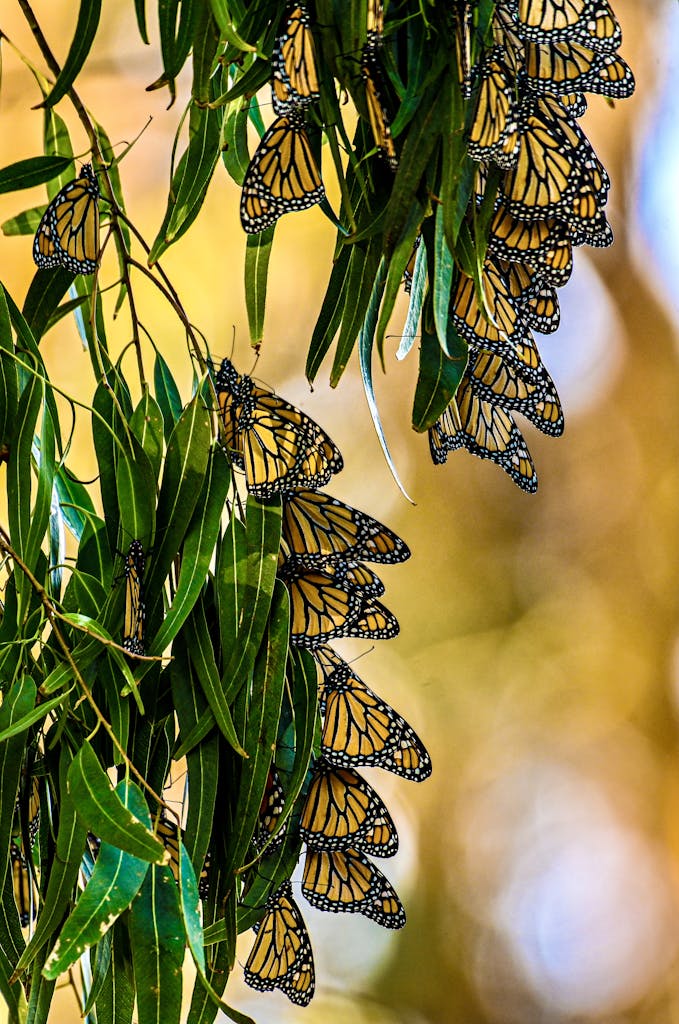
As human beings we can learn a lot from nature, so I would like to leave you with the story of the monarch butterfly. This is a species that migrates from Canada and the northern parts of the USA to Mexico from September to November for the winter.
This migration is an annual, multi-generation event – the butterfly that sets out from the north is not the one who reaches the south. It lays eggs as it moves southwards, and those eggs hatch into caterpillars that grow into butterflies that complete an additional leg southwards before they die.
Now consider this – each butterfly is moving south – oriented to the long arc of the future, but they aren’t moving forward in a grim procession, focused on covering the maximum distance. No!
Each butterfly dances through the sky, sipping nectar from the flowers that blossom along the way – yes, the joy of that one little butterfly matters deeply. And as she flits from flower to flower, she carries pollen on her feet, doing the work of pollination- the butterfly’s version of present impact.
Can you see how the Mariposa Monarch inhabits all three axes so naturally, and with such grace?
We are called to do the same, for this work isn’t meant to be grim and joyless.
And if you would like to find out more about how joy can fuel what matters most to you, the work of personal and collective liberation, I invite you to experience the Incandescent Joy Challenge – a free 5 day email-based program that you can try out at your own pace and in the comfort of your home. You can find out more about the Incandescent Joy Challenge here.